The 2023–24 edition of the North Eastern Region Sustainable Development Goals (SDG) Index, jointly published by NITI Aayog, the Ministry of DoNER, and the United Nations Development Programme (UNDP), presents a detailed picture of the progress of the Sustainable Development Goals (SDGs) at the district level across the Northeastern (NE) states. This index aims to evaluate the local-level implementation of SDGs and identify the regional gaps and achievements.
Key Highlights of Sustainable Development Goals Index
Assam’s Low Ranking in SDG Index
- No district from Assam features in the top 10 districts of the Northeast in SDG performance.
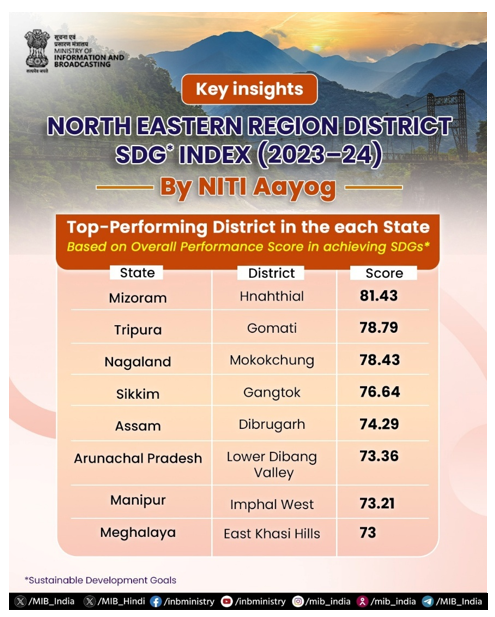
- The highest-ranked district from Assam is Dibrugarh, at 17th position, with a score of 74.29.
- Other top-ranking districts in Assam include Sivasagar (20th) and Jorhat (21st), indicating a modest level of achievement.
- South Salmara-Mankachar is among the lowest-ranked districts in the entire NE region, placed at 118 out of 121. Other low-ranking districts from Assam include West Karbi Anglong (108), Udalguri (102), Baksa (97), and Barpeta (94).
Top Performing Districts in NE
- Mizoram leads the region with Hnahthial district scoring 81.43, followed by Champhai (Mizoram), Gomati (Tripura), Mokokchung (Nagaland), and others.
- All districts in Mizoram, Tripura, and Sikkim fall in the ‘Front Runner’ category (score 65–99), indicating substantial progress across multiple SDGs.
- No districts from any state fall under the ‘Aspirant’ (score 0–49) or ‘Achiever’ (50–64) categories.
Thematic Challenges
- The report identifies geographical constraints, such as mountainous terrain, dense forests, and poor connectivity, especially in parts of Arunachal Pradesh, as major hindrances to industrialization and infrastructure development.
- These limitations significantly affect progress in SDG 9 (Industry, Innovation and Infrastructure) and related goals like SDG 8 (Decent Work and Economic Growth).
Education Concerns
- A high dropout rate in secondary education (Class 9–10) is a critical issue. The average dropout rate in the NE is 10.9%, higher than the national average of 14.1% (as per UDISE+ 2023–24), with some districts showing even worse performance.
- School infrastructure remains underdeveloped in many districts, affecting the quality of education (SDG 4).
Environmental Degradation
- Forest cover in the region has witnessed a significant decline. According to the India State of Forest Report (ISFR) 2023, 72 districts in NE reported a reduction in forest cover compared to 2021, raising serious environmental and ecological concerns.
- The impact is especially critical considering the region’s biodiversity and dependence on forest resources, which directly links to SDG 13 (Climate Action) and SDG 15 (Life on Land).
Energy and Cooking Fuel Access
- Use of clean cooking fuel remains limited. Around 75% of NE districts lag behind the national average in terms of households with access to clean cooking energy, directly impacting SDG 7 (Affordable and Clean Energy) and SDG 3 (Good Health and Well-being).
Assessment Framework and Methodology:
- The second edition of the North Eastern Region SDG Index assesses 131 districts, out of which 121 had sufficient data for evaluation.
- The index covers 84 indicators across 14 out of 17 SDGs, drawing from data provided by various Union ministries and state departments.
Analysis and Implications
The SDG Index for NE reveals a multi-layered development disparity within and among northeaster states. While states like Mizoram, Tripura, and Sikkim have demonstrated commendable performance, Assam—despite being one of the most populous and resource-rich NE states—has shown patchy and inconsistent progress. The lack of infrastructure, high dropout rates, and poor forest governance highlight systemic developmental deficits that demand urgent policy attention.
Moreover, the low performance in access to clean energy and school education in a region with fragile ecology and diverse ethnic composition underlines the importance of decentralized, context-specific development strategies.
The index also emphasizes the importance of data-based governance, where performance monitoring at the district level can better inform targeted interventions and fiscal allocations under schemes like Aspirational Districts Programme and PM-DevINE (Prime Minister’s Development Initiative for North East Region).
The findings of the North Eastern Region SDG Index 2023–24 offer both a wake-up call and a guiding tool for state governments, civil society, and policymakers. As India aims to achieve the SDGs by 2030, ensuring balanced regional development—especially in sensitive and lagging regions like Northeast India—is essential. Without focused interventions in education, environment, infrastructure, and health, the region risks being left behind in the national growth narrative.
Read: Electoral Bonds and the democratic Dilemma
Download App: