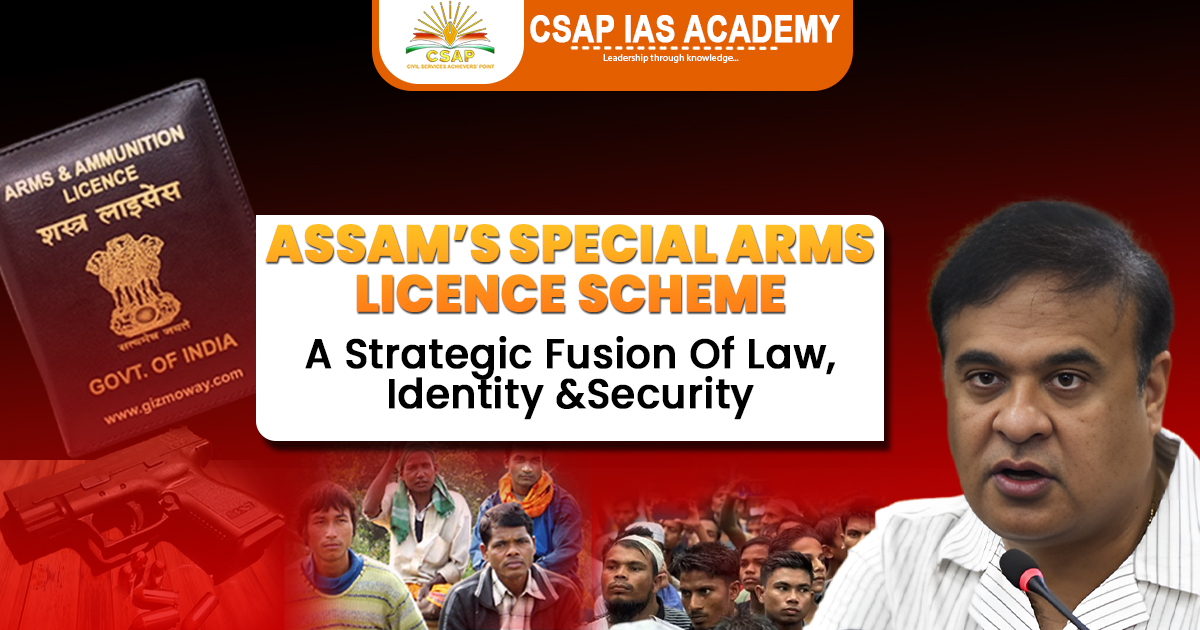
The Government of Assam has recently introduced a Special Arms Licence Scheme aimed at safeguarding the indigenous population residing in vulnerable and sensitive areas of the state.
The state-specific policy is issued under the framework of the Arms Act, 1959, and the Arms Rules, 2016, and allows eligible indigenous residents of Assam living in identified vulnerable areas to obtain a firearms licence through a simplified but strictly regulated process.
Objectives of Special Arms Licence scheme
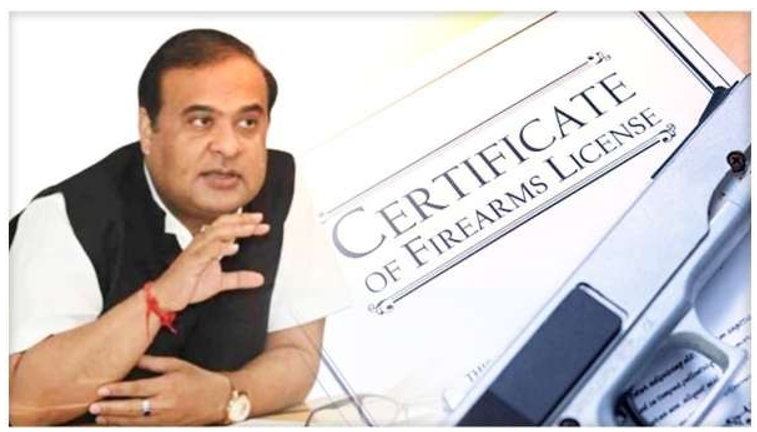
- To empower indigenous residents in vulnerable areas with legal arms for self-defence, ensuring they act as first responders amid delayed police
- The scheme seeks to protect indigenous communities facing demographic shifts, instil confidence in state support, and deter illegal encroachments in border and forest-fringe areas.
- Streamline arms licensing through a digital portal, ensuring rigorous multi-agency vetting while promoting transparency, accountability, and non- transferable licences subject to periodic reviews.
Eligibility Criteria
Applicants must meet the following criteria:
- An indigenous citizen of Assam
- Reside in vulnerable and remote
- Must not have a criminal background or pending
- Should be physically and mentally
- At least 21 years old
- A training certificate under the Arms Rules,
Application Process for the Special Arms Licence Scheme
Step 1: Meet the Aforementioned Eligibility Conditions
The first step for an applicant is to ensure they meet the above-mentioned eligibility conditions
Step 2: Sewa Setu portal
Applications are submitted online through the Sewa Setu portal under the Home & Political Department of Assam.
Two separate forms need to be filled out:
- The Special Scheme Application Form (declaring indigenous status and security concerns).
- The Form III Arms Licence Application (The statutory licence application).
Step 3: Online Registration and Form Submission
Applicant must create a profile on the Sewa-Setu portal and must upload
- Identity and residence proofs
- Age proof
- Indigenous inhabitant certificates
- Self-declaration regarding perceived security
- Arms training certificates
- Medical fitness proof and
- Other required
Step 4: Payment of Fees
Applicants are required to pay the statutory arms licence fee along with a portal convenience fee.
Step 5: Verification and vetting
Once submitted, the application undergoes multiple layers of verification:
- Local Police Verification: Checks antecedents and criminal records.
- Intelligence Inputs & Superintendent of Police Recommendation: Assessment of the applicant’s threat
- District Magistrate’s Scrutiny: The DM acts as the
licensing authority and may conduct interviews to assess suitability.
Step 6: Grant of Licence
If the application is approved, the DM issues a Form III Arms Licence. The licence is non-transferable, valid for five years and subject to periodic reviews.
Step 7: Acquisition of Firearms and Endorsement
The license only grants permission; it does not provide a weapon. The licensee must purchase a firearm from an authorized dealer at their own cost.
Step 8: Compliance and Renewal
Licence holders must adhere to all storage, carriage and usage conditions. The license must be renewed 60 days before expiry through the Sewa Setu portal.
Conclusion
The Special Arms Licence scheme of Assam represents a unique blend of security policy, identity protection and administrative reforms. On one hand, it seeks to empower indigenous residents living in vulnerable areas by granting them legal means and on the other hand, it reflects the state’s attempt to address demographic concerns and identity-based insecurities by strengthening the confidence of original inhabitants. However, the initiative is not without challenges.
Concerns exist about the potential risks of weapon proliferation, the capacity of local administration to carry out full-proof verification and broader implications of encouraging civilian armament in sensitive areas. These issues demand continuous monitoring, strict enforcement and periodic reviews to prevent misuse while retaining the scheme’s core intent.
Read: Sustainable Development Goals Index in Northeast India
Download App: