
India’s performance in the QS World University Rankings 2026 marks a defining moment in the trajectory of its higher education system. With 54 institutions making it to the list, India has achieved its best-ever representation, becoming the fourth most represented country globally, behind only the United States, the United Kingdom, and China. This achievement is not only a matter of numbers but a reflection of the gradual yet meaningful transformation in India’s academic quality, global visibility, and research ecosystem.
Highlights of India’s QS World University Rankings 2026 Performance
- 54 Indian institutions are ranked globally — the highest ever for the country.
- 8 new Indian universities entered the list in 2026 — the highest addition by any country this year.
- Of these 8, 7 are private institutions, reflecting the growing role of private Higher Educational Institutions (HEIs) in India.
- Top-ranking institutions:
- IIT Delhi – Global Rank: 123 | Indian Rank: 1
- IIT Bombay – Global Rank: 129 | Indian Rank: 2
- IIT Madras – Global Rank: 180 | Indian Rank: 3
Factors Contributing to the Rise
Improved Employer Reputation
- Indian institutions, particularly in STEM fields, are increasingly recognized by global recruiters.
- IIT Delhi ranks 50th globally in employer reputation, reflecting strong industry acceptance of Indian graduates.
Higher Research Output
- Enhanced research infrastructure and increased publication in indexed journals have pushed Indian institutions upward.
- IIT Delhi ranks 86th in citations per faculty, signaling strong research productivity.
Global Collaborations
- Indian universities have signed MoUs with top global institutions, leading to co-authored research, student exchange, and joint projects.
- This has enhanced India’s academic credibility and internationalization.
Sustainability Metrics
- QS introduced sustainability as a ranking criterion in 2026.
- IIT Delhi secured the 172nd global rank in sustainability, reflecting efforts toward green campuses and SDG alignment.
Institutional Reforms and Autonomy
- Initiatives like Institutions of Eminence (IoE) and National Institutional Ranking Framework (NIRF) have pushed institutions toward performance-based evaluation and strategic autonomy.
- Increased funding and less bureaucratic interference have enabled select institutions to pursue excellence.
Challenges Still Persist
Despite this milestone, the Indian higher education sector continues to face systemic challenges that hinder its transformation into a globally competitive academic ecosystem.
Quality Gaps in Private HEIs
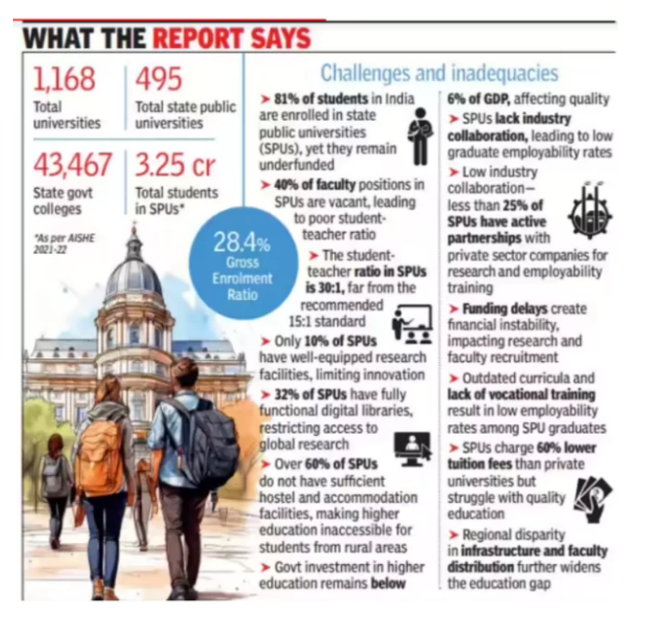
- Although private university enrollment grew by 497% between 2011–12 and 2021–22, many such institutions lack transparency, research focus, and quality control.
- The absence of strong regulatory oversight has allowed commercialization to creep into academia.
Faculty and Infrastructure Shortages
- As per NITI Aayog, over 40% of faculty positions in state public universities remain vacant.
- Outdated infrastructure, poor hostel conditions, and limited access to labs and libraries further hinder quality learning.
Low Government Spending
- India’s public spending on education is around 3% of GDP, much lower than the 6% target set by NEP 2020.
- Although the education budget for 2025-26 is ₹50,077.95 crore, it remains inadequate given rising enrollments and aspirations.
Regulatory Bottlenecks
- Reforms such as the creation of the Higher Education Commission of India (HECI) to replace the outdated UGC Act, 1956, have not been implemented.
- Delays in NEP rollout—such as Academic Bank of Credits, Digital Universities, and Multidisciplinary Education and Research Universities (MERUs)—impact momentum.
Way Forward
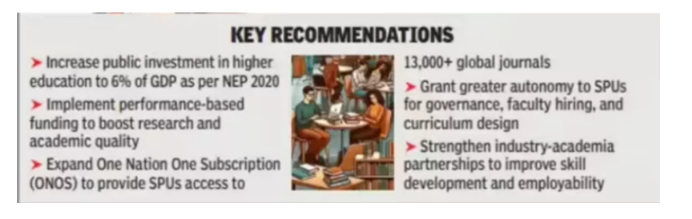
Accelerate NEP 2020 Implementation
Set clear timelines for reform rollout, such as credit transfer systems, governance restructuring, and digitization.
Strengthen Public Institutions
Fill faculty vacancies, modernize infrastructure, and promote research and innovation through sustained funding.
Ensure Quality in Private HEIs
Introduce mandatory accreditation, regular assessments, and transparent disclosures to uphold academic standards.
Promote Industry-Academia Synergy
Foster innovation ecosystems through research parks, startup incubators, and curriculum aligned with real-world skills.
Boost Global Integration
Encourage student/faculty exchanges, dual-degree programs, and participation in global academic forums.
Conclusion
India’s performance in the QS World University Rankings 2026 is a recognition of its rising academic profile and global engagement. However, rankings alone cannot transform education. To translate this visibility into inclusive, equitable, and quality education, India must prioritize policy execution, regulatory reform, and investment in public education infrastructure.
Only then can India truly emerge as a global knowledge hub and harness its demographic dividend effectively in the coming decades.
Read: Ambubachi Mela
Download App: