

The Citizenship (Amendment) Act, 2019 (CAA) is a significant piece of legislation that has sparked widespread discussion and debate across India. For civil service aspirants, understanding the nuances of this act is essential, as it frequently features in competitive exams like the UPSC and state public service commissions.
In this blog, we will discuss the key features, eligibility, and controversies of the Citizenship (Amendment) Act, 2019, providing you with a comprehensive understanding to excel in your preparation.
Introduction to the Citizenship (Amendment) Act, 2019
The Citizenship (Amendment) Act, 2019 aims to facilitate grant of citizenship to migrants belonging to Hindu, Sikh, Buddhist, Jain, Parsi or Christian community from Pakistan, Bangladesh and Afghanistan who entered into India on or before the 31.12.2014 and who have been exempted by the Central Government by or under clause (c) of sub-section (2) of section 3 of the Passport (Entry into India) Act, 1920 or from the application of the provisions of the Foreigners Act, 1946 or any rule or order made there under.
The Citizenship (Amendment) Act, 2019 has been notified on 12.12.2019 and has come into force w.e.f. 10.01.2020.
The 2019 CAA amended the Citizenship Act of 1955 allowing Indian citizenship for Hindu, Sikh, Buddhist, Jain, Parsi, and Christian religious minorities who fled from the neighboring Muslim majority countries of Pakistan, Bangladesh and Afghanistan before December 2014 due to “religious persecution or fear of religious persecution”.
✓ However, the Act excludes Muslims.
- Under Citizenship (Amendment) Act, 2019 amendment, migrants who entered India by December 31, 2014, and had suffered “religious persecution or fear of religious persecution” in their country of origin, were made eligible for citizenship by the new law.
- These types of migrants will be granted fast track Indian citizenship in six years. The amendment also relaxed the residence requirement for naturalisation of these migrants from eleven years to five.
- Relaxations
Under The Citizenship Act, 1955, one of the requirements for citizenship by naturalisation is that the applicant must have resided in India during the last 12 months, as well as for 11 of the previous 14 years.
✓ The amendment relaxes the second requirement from 11 years to 6 years as a specific condition for applicants belonging to these six religions, and the aforementioned three countries.
- Illegal Migrant
Under the Act, an illegal migrant is a foreigner who
✓ Enters the country without valid travel documents like a passport and visa, or
✓ Enters with valid documents, but stays beyond the permitted time period.
Exemption of the Citizenship (Amendment) Act, 2019
It exempts the members of the six communities from any criminal case under the Foreigners Act, 1946 and the Passport Act, 1920. The two Acts specify punishment for entering the country illegally and staying here on expired visas and permits.
Sixth Schedule
The provisions of the Act will not apply to the tribal areas of Assam, Meghalaya, Mizoram or Tripura as included in the Sixth Schedule to the Constitution and States of Arunachal Pradesh, Mizoram and Nagaland that are protected by the Inner Line Permit (ILP).
Later, Manipur was added to the list of exempted States. This means that those “illegal” migrants who will be deemed Indian citizens through the Act will not be able to settle down in the exempted areas.
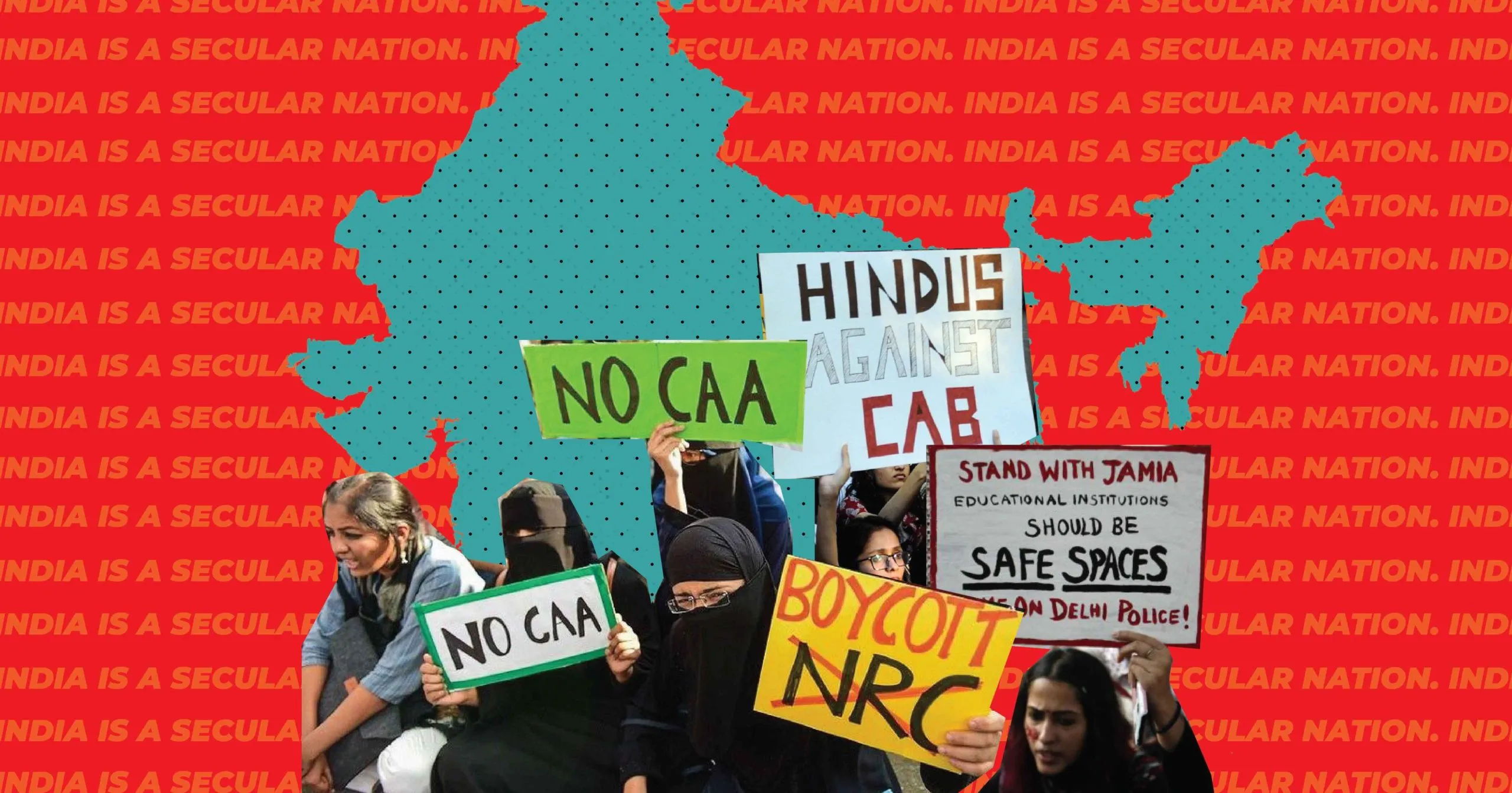
The Citizenship (Amendment) Act, 2019 is Unconstitutional
- The law was challenged before the Supreme Court under Article 32 of the Constitution.
- The challenge rests primarily on the grounds that the law violates Article 14 of the Constitution that guarantees that no person shall be denied the right to equality before law or the equal protection of law in the territory of India.
It is Anti-Muslim
Those challenging the law argue that if protecting persecuted minorities is ostensibly the objective of the law, then the exclusion of some countries and using religion as a yardstick may fall foul of the test.
Against the basic structure of the constitution
Granting citizenship on the grounds of religion is seen to be against the secular nature of the Constitution which has been recognised as part of the basic structure that cannot be altered by Parliament.
Debate of reasonable classification
In the CAA challenge, the petitioners have asked the Court to look into whether the special treatment given to “persecuted minorities” from three Muslim majority neighbouring countries only is a reasonable classification under Article 14 for granting citizenship, and whether the state is discriminating against Muslims by excluding them.
Why is the northeast against the Citizenship (Amendment) Act, 2019?

- The north-eastern states have for long faced large scale migration from neighbouring countries.
- There were protests from indigenous residents over the strain this migration placed on the social, economic, and political fabric of the region.
- The protest against the provisions of the CAA in these states is against legitimization of all immigrants from any country irrespective of their faith rather than excluding only Muslims.
Exceptions to the Citizenship (Amendment) Act, 2019
The CAA will not apply to tribal area of Assam, Meghalaya, Mizoram, or Tripura as included in the Sixth Schedule to the Constitution and the area covered under The Inner Line notified under the Bengal Eastern Frontier Regulation, 1873.
- Apart from the above exceptions, the law shall be applicable across all states.
- The Chief Ministers of Kerala, Punjab, West Bengal, Chhattisgarh, and Madhya Pradesh have stated that they will not implement the act in their respective states.
- However, states may not have the power to refuse implementation of the law, as it is enacted under the Union List of the Seventh Schedule of the Constitution.
Read: Assam Accord, 1985
Download App: