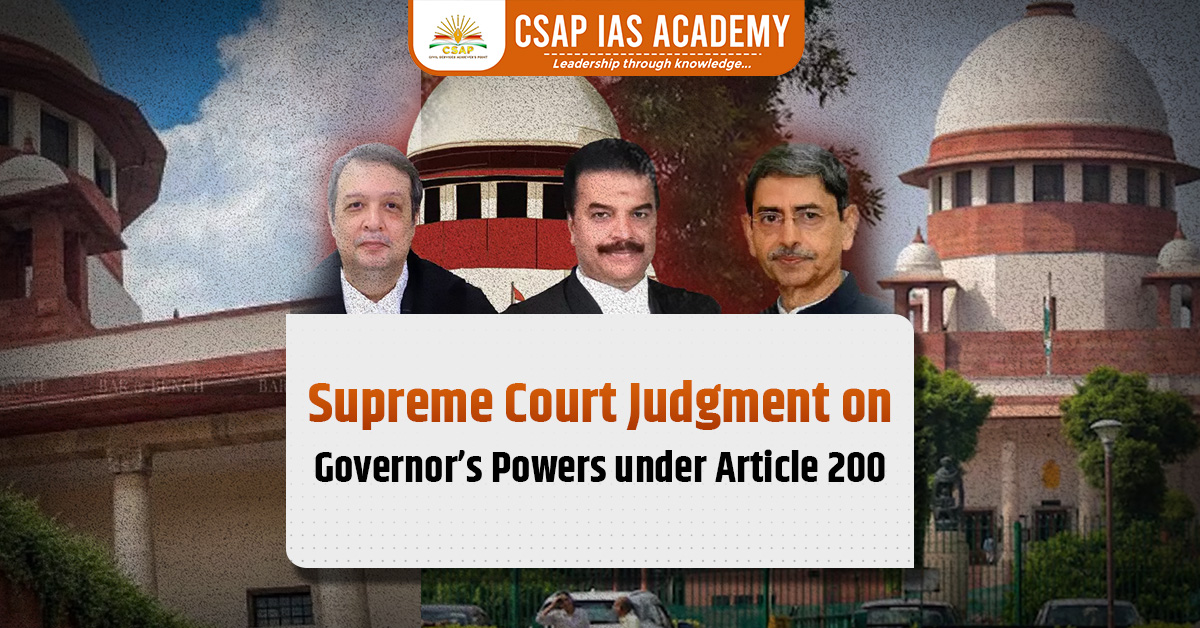
In this article, we will discuss the Supreme Court’s recent judgment on Article 200 of the Indian Constitution, which clarifies the powers and responsibilities of State Governors when dealing with bills passed by State Legislatures. Prompted by delays in Tamil Nadu, the Court laid down strict guidelines to prevent misuse of authority, ensure timely action, and uphold the democratic process. This verdict marks a significant step in strengthening federalism and reinforcing constitutional accountability.
Context and Background
In a landmark decision delivered in April 2025, the Supreme Court of India clarified the powers and responsibilities of State Governors under Article 200 of the Constitution. The ruling came in response to delays and constitutional questions surrounding the Governor of Tamil Nadu’s decision to reserve ten State bills for Presidential consideration even after they had been re-enacted by the State Legislature. This act was challenged as a violation of constitutional propriety and the democratic mandate.
The two-judge Bench comprising Justice J.B. Pardiwala and Justice R. Mahadevan delivered a comprehensive judgment that now serves as a constitutional guideline for how Governors must act on bills passed by State legislatures.
Article 200: Constitutional Provision

Article 200 of the Indian Constitution provides the Governor with three options when a bill passed by the State Legislature is presented for assent:
- Grant Assent to the Bill, making it law;
- Withhold Assent, effectively blocking the bill;
- Reserve the Bill for the Consideration of the President, if the Governor believes it conflicts with central laws or raises constitutional issues.
The Constitution does not mention a timeline within which the Governor must act, but uses the phrase “as soon as possible” in the proviso to Article 200.
Key Findings and Directives of the Supreme Court
No Pocket Veto or Indefinite Delay
The Court categorically ruled that Governors do not possess a veto power akin to the U.S. President’s pocket veto. The Governor cannot refuse to act on a bill indefinitely or delay action without valid constitutional reasons. The phrase “as soon as possible” imposes a constitutional obligation of urgency.
The Court emphasized that the role of the Governor is not that of an opponent to the legislature, but a constitutional authority bound to respect the democratic will of the people.
Timelines for Governor’s Action
Though the Constitution does not prescribe fixed time limits, the Court laid down specific timelines to ensure accountability and prevent arbitrary delays:
- If the Governor withholds assent or reserves the bill, they must act within one month, following the advice of the State Council of Ministers.
- If the Governor withholds assent contrary to the advice of the Council of Ministers, the bill must be returned to the legislature with a message within three months.
- If the Governor reserves a bill for the President against ministerial advice, it must be done within three months.
- If the bill is reconsidered and re-passed by the legislature, the Governor must grant assent within one month.
Failure to follow these timelines will expose the Governor’s inaction to judicial review.
Governor’s Actions Subject to Judicial Review
The Supreme Court held that actions or inactions of the Governor under Article 200 are subject to judicial scrutiny. The Court asserted that any decision by the Governor—such as withholding assent or reserving a bill for Presidential consideration—must have constitutional justification.
The Court reiterated that judicial review is a basic feature of the Constitution and can be invoked if the Governor misuses their authority or delays action in a manner that affects legislative functioning.
Reservation Power Cannot Be Misused
In a significant observation, the Court ruled that once a bill is returned by the Governor and then re-passed by the legislature, the Governor cannot again reserve it for the President. This would otherwise defeat the legislative process and constitutional intent.
The Court found the Tamil Nadu Governor’s act of reserving ten re-enacted bills for Presidential assent to be illegal. Accordingly, it ruled that such action was an erroneous exercise of power.
Using its powers under Article 142 of the Constitution, which allows the Supreme Court to ensure complete justice, the Court held that those bills shall be deemed to have received the Governor’s assent on the day they were re-passed by the legislature.
Governor Must Act on Advice of Council of Ministers
The Court reaffirmed the principle laid down in the Shamsher Singh v. State of Punjab (1974) case that the Governor is a constitutional head and must act on the aid and advice of the State Council of Ministers in all matters, unless the Constitution specifically allows discretion.
The ruling also overruled a contrary interpretation in the BK Pavitra case, where it was previously suggested that the Governor enjoys discretion in reserving bills for Presidential consideration. The Court clarified that such discretion does not exist unless explicitly provided by the Constitution.
Significance of the Judgment
- Strengthens Federalism: Ensures that Governors do not act as political agents of the Union and respects the democratic mandate of elected State governments.
- Enhances Accountability: By introducing judicially enforceable timelines, the judgment makes the Governor’s office more accountable to constitutional norms.
- Checks Arbitrariness: Prevents misuse of Article 200 to delay or derail State legislation.
- Affirms Constitutional Morality: Reinforces the expectation that constitutional authorities must act in good faith, promptly, and within the framework of the Constitution.
Conclusion
This Supreme Court verdict is a watershed moment in constitutional law, especially in the evolving landscape of Centre-State relations. It ensures that the Governor’s office is not misused to frustrate the democratic process and that legislative actions of elected governments are respected and facilitated as per constitutional norms.
Read: India-Sri Lanka Defence Agreement
Download App: